
- Time
- Half a day insideTwo days if you add Jingshan and the hutongs
- Entry
- ¥60 $9¥20 $3 extra for the Treasure Gallery
- Booking
- Passport onlyNo ticket window sells to foreigners any more
- Closed
- MondaysExcept public holidays
Seventy-two hectares, nine thousand rooms, 24 emperors, and one straight line running south to north through all of it. The Forbidden City is the largest palace complex ever built and the most visited museum on earth — and yet the hall everyone comes to see was, for most of its five centuries, almost never used for anything.
The three things worth your time
The Hall of Supreme Harmony 太和殿
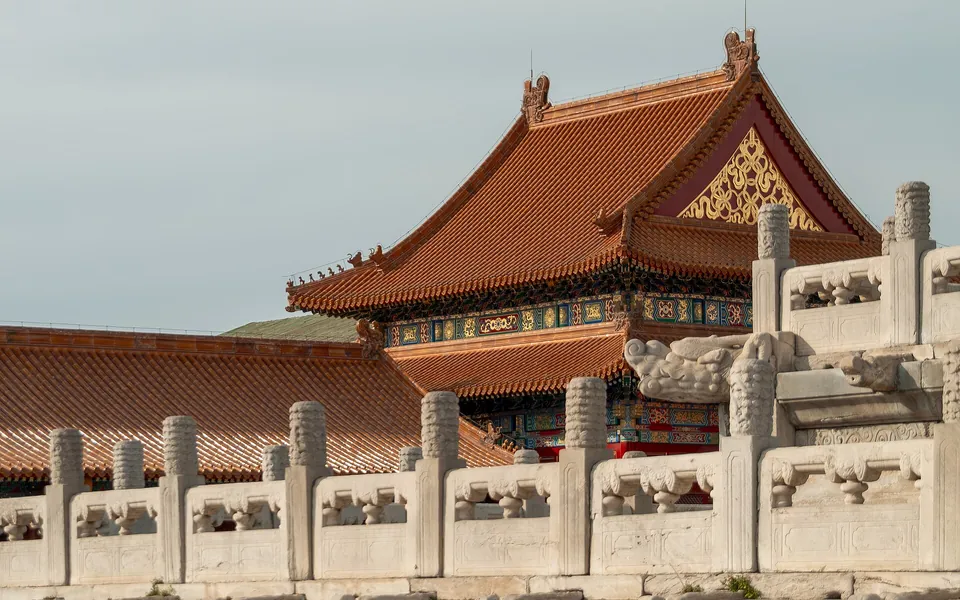
The largest timber hall still standing in China: eleven bays wide, on a three-tier marble terrace, under a double-eaved roof guarded by ten roof figures instead of the usual nine. It was built for the moments that mattered — an emperor taking the throne, an imperial wedding, the naming of an empress, a general leaving for war. On an ordinary morning it stood empty. The emperor did his actual work in a much smaller hall behind it.
Which is why the crowd in front of it is standing in the wrong place. Everyone is up on the terrace, phones raised, shooting into the eaves. Walk down the steps and shoot back up: the staircase compresses the whole building into one frame, and the bronze turtles at the bottom give it a scale no drone shot has.
The Treasure Gallery 珍宝馆
¥10 $1.50 on top of your ticket, on the east side through the Nine Dragon Screen, and the best hour in the complex. This is where the portable wealth went: the 金瓯永固杯, the gold cup the emperor filled on New Year's morning to write the first stroke of the year's first character; jade; and the phoenix crown of a Ming empress, recovered from a tomb excavation and rebuilt wire by wire.
Check before you commit. In 2026 the crown is not on display — the gallery rotates — and the ticket window shuts at 16:00, half an hour before you are allowed through the door. If you only have half a day, this is the thing to cut, not the great halls.
Jingshan 景山
Outside the north gate, ¥2 $0.30, fifteen minutes to the top. It is the only place the scale makes sense: from the Wanchun Pavilion you see the whole yellow roofscape at once, 72 hectares of it, ending at the Drum and Bell towers. Go at the end, not the beginning. And take the east flank of the hill, which is emptier than the central stairs.
The walk
Four hours, about 12,000 steps, one rule: get in from the east, push north up the axis in a single run, then work your way back down the eastern side. You will pass the same buildings with a fraction of the crowd.
1. East Glorious Gate 东华门, not the front
Metro Line 8 to Jinyu Hutong, then west along the moat. This is the back door and almost nobody uses it: one security check, ten minutes, and you arrive at the Meridian Gate already inside the perimeter. The route most guides give you — Line 1 to Tian'anmen East, north through the square — means a second security check, a queue that can run forty minutes, and a crowd that never thins.
There is a third way, if the queue is bad: from Tian'anmen East exit B, walk north into 南池子, turn into the lane opposite the Hanting Hotel, buy a ¥2 $0.30 ticket to the Working People's Cultural Palace, and leave by its west gate. You come out at the Meridian Gate having queued for nothing.
2. The Meridian Gate 午门
The only entrance, and the one place in the complex where the architecture is openly doing an intimidation job. Five openings: the central one for the emperor, the two beside it for the nobility, the two outermost for everyone else. Look up at the wings as you pass through — they are shaped to enclose you.
Then keep moving. The golden-water bridges are worth thirty seconds, not ten minutes.
3. The Three Great Halls 三大殿
太和殿, 中和殿, 保和殿, in that order, on one shared terrace. Walk them fast the first time.
中和殿 was the prep room — the emperor waited here while the ceremony was assembled and rehearsed the wording. 保和殿 is where the Qing held New Year banquets for the nobility, and from Qianlong's reign the final round of the imperial examinations: essays written in a cold hall, for a job at the top of a bureaucracy of twenty thousand.
The terrace underneath all three is the thing to look at. Three tiers of marble, each with its own balustrade, and every baluster head carved as a dragon — spouts, so that in a storm the entire platform appears to be spitting water.
4. The private half 后三宫
Through 乾清门 and the architecture changes: smaller halls, tighter courtyards, walls that actually block sightlines. This is where the emperor lived rather than performed.
乾清宫 holds the 正大光明 plaque, and behind it, from Yongzheng onward, a sealed box with the next emperor's name inside — one copy on the sovereign's person, one behind the board, opened only after death. A system built to stop the succession wars that had ruined every previous dynasty. It mostly worked.
交泰殿 holds twenty-five imperial seals, each in its own case: the physical instruments of rule, lined up like a toolkit.
坤宁宫 was the empress's hall, which the Qing converted into a Shamanist ritual space — cauldron, kang, sacrifices — while keeping the eastern chamber as the wedding suite. The last emperor was married in it in 1922, eleven years after the dynasty had already fallen.
5. The east side 养心殿 and 宁寿宫
养心殿, west of 乾清宫, is where the Qing emperors actually governed from: small, dark, unimpressive, and one-way. You enter through 遵义门 and leave through 吉祥门, and there is no going back.
Then cut east to 宁寿宫, the retirement complex Qianlong built and never moved into, which now holds the Treasure Gallery and the Clock Gallery. The clocks are the surprise: a gilt-bronze figure that dips a brush in ink and writes 八方向化,九土来王 in perfect characters, and a palace clock that ran two time systems at once — Western hours on the dial, the traditional five watches on a separate ring.
Walk back out along 东筒子夹道, a long straight lane between two high red walls. It is where half the photographs of the Forbidden City you have ever seen were taken.
6. Out the north gate
神武门 opens onto a road, a moat, and Jingshan. There are no benches outside. Inside, near the exit, there are dozens — sit down before you leave, because the last hour is the one that hurts.
The numbers
| Open | 08:30–17:00. Closed Mondays except public holidays |
|---|---|
| Peak ticket | ¥60 $9, April–October |
| Off-peak | ¥40 $6, November–March |
| Treasure Gallery | ¥10 $1.50, sold until 16:00, last entry 16:30 |
| Clock Gallery | ¥10 $1.50 |
| Booking | Seven days ahead at 20:00 Beijing time, official WeChat mini-program, passport number. No tickets at the gate |
| Time | 3.5–4 hours for the axis plus the east side; 6 for the full circuit |
| Steps | About 12,000 |
What nobody tells you
- The hall you came for was ceremonial. 太和殿 hosted a few dozen events in five centuries. Governing happened in 乾清宫 and later 养心殿, both a third its size.
- The Treasure Gallery closes early. Tickets stop at 16:00, entry at 16:30. Arrive after 15:00 and buy the add-on the moment you see the window, not when you reach the door.
- 2026 is not a normal year. The phoenix crown is off display; 永寿宫 and 文华殿 are closed for work. Ask at the ticket window what is actually open — the printed map does not say.
- 景阳宫 you cannot enter. There is a door with a gap in it, and you look through the gap.
- The wings are empty. Everyone crowds the axis. Walk two minutes sideways to 十八槐 or 断虹桥 and you will have courtyards to yourself.
- Afternoon beats morning. At 12:45 the queue at the gate is five minutes; at 08:30 it is an hour. The palace closes at 17:00 either way.
- 御花园 has two carved ceilings that nearly everyone walks under without looking up.
The rest of the day
The Forbidden City sits in the middle of one straight north–south line through the old city. The four stops are walked in order, in a single day. One of them has a full page; the other three are notes, for now.
-
Tian'anmen Square 天安门广场
Where every visit starts, and the only place in Beijing where the queue itself is the attraction. Book the free slot on the square's own mini-program a day ahead — slots open seven days out at noon. If you want the flag-raising, that is a separate dawn slot, not the general one. There is also a fast lane on the Jingtong app that almost nobody uses: it must be booked before the day, and it turns a forty-minute wait into a walk-through.
-
The Forbidden City 故宫
The page you are reading.
-
Jingshan Park 景山公园
Written up above, under the three things — it is the one view that explains the whole palace. Come at sunset. At midday the light is flat and the marble terraces wash out to white.
-
Qianmen & Dashilan 前门 · 大栅栏
The old commercial street, and the right place to end the day: the lanterns come on after dark, the tour groups have gone, and the food is better and cheaper than anything inside the palace walls. Two blocks east, 鲜鱼口 is the lane locals still use.
One of the four stops is written. The square, Jingshan and Qianmen are on our list.
Getting there
Metro Line 8 to Jinyu Hutong, then ten minutes west on foot to 东华门. Bring your passport — it is checked at the gate and again at the ticket scan, and the whole square outside is a checkpoint you cannot cross without it.
North of the wall
Behind the north gate the city changes completely: single-storey grey-brick lanes, shared courtyards, bicycles. 南锣鼓巷 is the famous one and is now a souvenir corridor. Two streets west, 宝钞 or 帽儿, and it goes back to being a neighbourhood — old men on stools, a noodle shop with six seats, laundry strung between trees.
Go late afternoon, when people come out and the light through the trees is the reason to be there at all.
Photograph by Reinhold Möller Ermell, CC BY-SA 4.0. Source.